
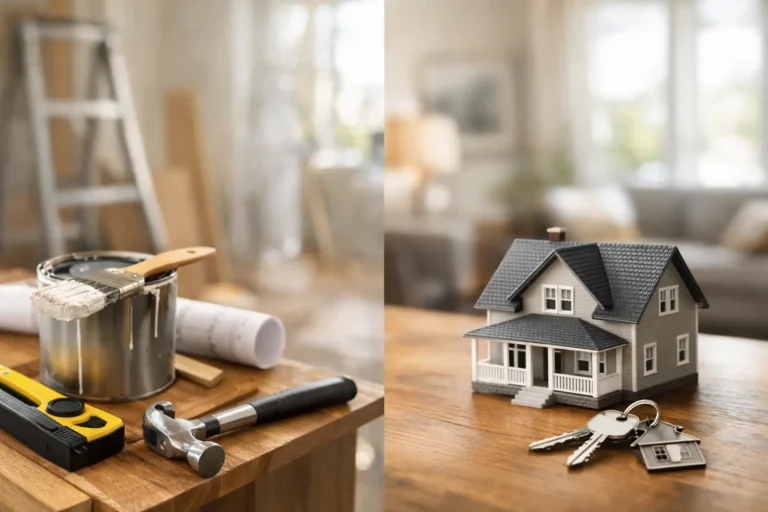
A tired weatherboard in the suburbs, an inherited unit with dated finishes, a family home that needs repairs after years of being lived in properly – these are the moments when owners start asking whether to renovate or sell property as is. It is rarely a purely financial question. In many cases, the right choice depends just as much on time, energy, cash flow and personal circumstances as it does on likely sale price.
For many Victorian owners, this decision arrives during a stressful period. You might be dealing with a deceased estate, separation, relocation, mortgage pressure, problem tenants or a property that has simply become too hard to manage. In those situations, advice that treats renovation as the default answer can miss the point. Sometimes improving the home is sensible. Sometimes selling without doing the work is the more practical and financially sound move.
When to renovate or sell property in Victoria
The first thing to understand is that not all renovations add value in a way that justifies the effort. A fresh coat of paint, basic landscaping and minor cosmetic updates can improve buyer appeal and make a property feel cleaner, brighter and better cared for. That is very different from taking on a full kitchen replacement, structural repairs or a half-completed renovation that has already drifted beyond budget.
In Melbourne and across Victoria, buyer expectations vary sharply by suburb, price point and property type. In some areas, buyers are happy to pay a premium for a move-in-ready home. In others, they expect older homes to need work and are comfortable taking on a renovation themselves. If your likely buyer is a builder, investor or experienced renovator, spending heavily before sale may not lift the result enough to cover the extra risk.
A useful way to think about it is this: are you considering renovation to make the property saleable, or to make it more competitive? If the home is safe, functional and legally able to be sold, then the decision becomes more strategic. You are not choosing between possible and impossible. You are choosing between pathways.
Start with the real constraints, not the dream result
Owners often begin with the highest possible resale figure in mind. That is understandable, but it can lead to poor decisions if the path to get there is unrealistic. Renovation takes money up front unless you have a deferred solution in place. It also takes time, project management and tolerance for uncertainty.
If the property is vacant and you have access to funds, flexibility on timing and a clear scope of works, renovation may be worth considering. If the property is tied up in probate, occupied by difficult tenants, affected by financial stress or part of a separation, the cleaner outcome may be to sell in its current condition or use a takeover solution that removes the burden from the owner.
There is also the emotional load. Many owners underestimate how draining it can be to prepare a property for sale when they are already dealing with life events. A renovation that looks simple on paper can become overwhelming once trades, compliance issues, hidden defects and holding costs start stacking up.
Renovation makes more sense when
Renovation is usually more attractive when the work is cosmetic rather than structural, the property is in a location where presentation strongly influences buyer competition, and the likely uplift is supported by local evidence rather than guesswork. A home that needs decluttering, paint, flooring, garden clean-up and a few practical updates may benefit from a managed improvement program.
It can also be the better option when the owner is not under immediate time pressure and wants help coordinating the work without taking on every moving part alone. In that situation, the goal is not overcapitalising. It is selecting the improvements most likely to influence buyer perception and final offers.
Selling as is makes more sense when
Selling without renovating can be the stronger option when repairs are extensive, cash flow is limited, or the owner needs certainty. It also suits properties with issues that buyers in that segment already expect, such as older homes on larger blocks, deceased estate properties, houses with unfinished works, or dwellings where compliance and condition may complicate a traditional campaign.
An as-is sale can reduce holding time, avoid renovation surprises and allow owners to move forward without months of preparation. For many people, that practical relief has real value. The best result is not always the highest theoretical number. It is often the outcome that balances price with speed, simplicity and reduced stress.
The numbers matter, but so does risk
One of the biggest traps in deciding whether to renovate or sell property is looking only at gross resale estimates. Owners may hear that a renovated version of the home could achieve a stronger figure, then assume the difference is profit. In reality, the gap has to cover works, contingencies, holding costs, selling costs and the possibility that the market changes while the property is being prepared.
Even a modest project can run into delays. Trades may be booked out. Materials may cost more than expected. Repairs behind walls or under flooring may only appear once work starts. If the property remains unsold for longer, there may also be extra mortgage repayments, council rates, utilities and insurance to carry.
That does not mean renovation should be avoided. It means the decision needs to be grounded in realistic numbers and a clear understanding of risk. A smaller, targeted improvement often outperforms an ambitious renovation that stretches the owner financially and emotionally.
What buyers actually respond to
Most buyers do not need perfection. They want clarity. They respond well to homes that feel maintained, clean and straightforward to understand. A property can be older and still present well. Likewise, a newly renovated property can still struggle if the works are inconsistent, poorly chosen for the area or raise questions about quality.
This is why selective preparation can be so effective. Cleaning, rubbish removal, simple repairs, paint touch-ups, garden maintenance and styling decisions can shift the feel of a home without pushing the owner into a full renovation. If the property has good bones, highlighting that may be enough.
On the other hand, if key spaces like kitchens and bathrooms are badly deteriorated, buyer feedback may become harsher and offers may narrow. The answer then depends on whether those updates can be done efficiently and whether the likely market will pay for them.
A practical way to decide
Before choosing a path, owners should look at four questions. First, what condition is the property really in, not emotionally, but practically? Second, who is the most likely buyer in the current market? Third, what are the true costs and risks of doing the work? Fourth, how much time and headspace do you have to carry the process through?
Those questions tend to cut through wishful thinking. They also help separate a property that needs strategic presentation from one that needs a completely different exit plan.
For some owners, the right answer is managed renovation support so the property can go to market in stronger condition. For others, the right answer is to sell as is, accept the convenience and avoid pouring more money into a difficult asset. There is no one-size-fits-all formula, particularly when personal circumstances are driving the timeline.
A good property decision should leave you with more clarity, not more pressure. If you are weighing up whether to improve a property or move it on as it stands, a calm assessment of the asset, the market and your situation usually reveals the best next step. Uplift Property Solutions helps owners work through these choices with practical support and clear options. If you need a straightforward path forward, reach out for a friendly conversation.